This report was prepared by the Prindex global research team. The following people have co-authored this report: Denys Nizalov, Anna Locke, Ian Langdown, Ruth Meinzen-Dick, Cheryl Doss, Malcolm Childress, Ivan Kolodiazhnyi and Artur Burak. The team thanks the Kyiv School of Economics’ Center for Food and Land Use Research for the technical support with development of this report. The report has also benefitted from contributions by Shahd Mustafa, Chryssy Potsiou, Kenneth Houngbedji, Daniela Behr, Victoria Stanley, Caitlin Kieran and Beth Roberts. Production of this report would not be possible without generous support by: The European Commission, International Fund for Agricultural Development and the International Land Coalition. The views presented in this report are those of the authors and do not necessarily represent the views of donor or partner institutions.
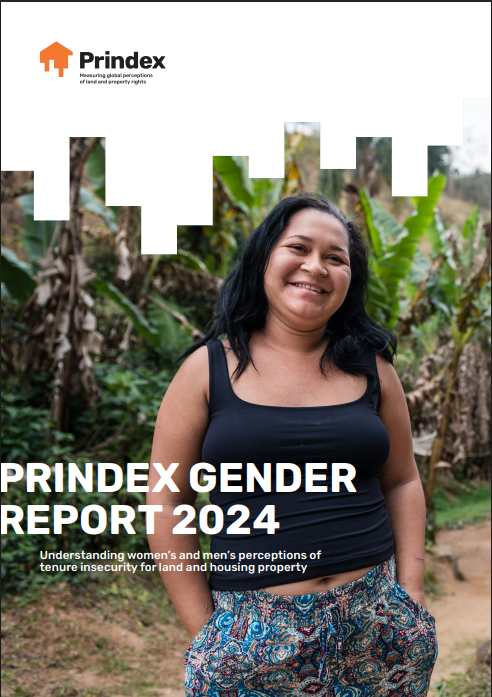
The Sustainable Development Goals (SDGs) indicators 1.4.2 and 5.a.1 recognise that strengthening gender equality in land and housing property rights is fundamental for poverty reduction and women’s empowerment. Securing women’s property rights can increase agricultural productivity, incentivise the adoption of climate-resilient natural resource management and increase household spending on health and education. Yet, in many parts of the world, women face legal or customary barriers to using or controlling land and other productive resources, often depending on others for this use. This not only places them on an unequal footing in life, but also restricts wider positive social, economic and environmental outcomes.
Why gender-equal tenure security matters
While men do not face the same bias in the legal and social treatment of their rights, norms fostering traditional or restrictive masculinity can tie men’s sense of success, social status and legitimacy to their ability to secure land or housing property. This can make men´s feelings of tenure (in)security vulnerable to specific stresses that affect their well-boing and economic opportunities.
Understanding the different ways that men and women experience tenure insecurity – and the sources of that insecurity – helps identify what needs to change in policy and practice in the land and housing property sector and beyond, to reap the benefits of stronger tenure security for women and men alike. Prindex surveys bring insight into these differences to a new level through two rounds of data collection, published in 2020 (Round 1) and 2024 (Round 2). By interviewing randomly selected members of households – men and women – rather than household heads, Prindex yields gender-disaggregated data for respondents in more than 100 countries and reveals changes across the four-year time period. Prindex measures people’s perceptions of their tenure security or insecurity by asking them to assess the risk of losing the right to use their land and housing property against their will in the foreseeable future.
What the Prindex data shows
It is estimated that in 2024, 593 million women and 613 million men were feeling insecure in relation to their property rights. The lack of a notable average difference between women’s and men’s tenure insecurity (the gender gap) at a locl level masks significant distinctions at regional and country level, and across high, middle and low-income countries. Country level analysis shows that there is still a long way to go for women’s land and housing property rights to be on par with men’s in particular regions and countries, and some worrying backsliding.
In certain regions, where discrimination against women is well documented, particularly the Middle East and North Africa (MENA) and Sub-Saharan Africa (SSA) regions, there are countries with significant and persistent gender gaps in overall tenure insecurity and reasons for insecurity, where women feel more insecure than men. These include the United Arab Emirates (UAE), the Republic of Congo and Zimbabwe. These gaps are linked to lower shares of women’s ownership of land and housing property, and higher rates of tenure insecurity in hypothetical scenarios of loss of spouses through death and divorce. South Asia–often identified as a region where women face discrimination in ownership, access and use of land and property — also shows a significant gender gap in the spousal death and divorce scenarios. Nevertheless, improvements in gender equity are observed in several countries in the region, notably India and Nepal, which may reflect recent reforms in inheritance law (India) and land registration (Nepal).
While Prindex findings emphasise the need to continue addressing barriers to women’s land and housing property rights, the survey also highlights the extent to which men’s tenure insecurity has worsened across the two rounds of data collection, particularly in high-income countries. In 11 countries, more men than women feel insecure about their ability to remain in their homes and on their land.
Different drivers of tenure insecurity for women and men
The data also reveals significant gender differences in the sources of tenure insecurity. As in Round 1, Round 2 shows that women more frequently report sources of tenure insecurity internal to the family or households - such as conflicts with family members - most notably in the MENA region. This indicates that women often depend on others for their use and control of land and housing property, with these rights conditional on their relationship with others. By contrast, men more frequently identify sources external to the household or community. There has been an increase in the frequency of specific external sources of insecurity reported by men, particularly lack of money (for rental and mortgage payments) and fear of government seizing property, reflecting broader trends in financial insecurity.
In 2024, women continue to feel more insecure about their property rights than men in most countries in the hypothetical scenarios of spousal death and divorce. Results for the spousal death scenario reflect broader trends in inheritance law: in countries where gender equality is not enshrined in law, women feel significantly more insecure following the death of a spouse.
The form of tenure held by men and women also matters for differences in perceived insecurity. Men disproportionately report ownership compared to women, and ownership is the most secure form of tenure. Women, by contrast, more frequently report using family-owned property, particularly in countries where more women report higher overall insecurity. Countries with policies encouraging women to register immoveable property, including through joint-titling, are associated with a smaller gender gap in ownership than countries without such policies. In countries where a higher proportion of men than women report feeling insecure, there is a disproportionately higher share of renters among men.
Implications for policy, practice, and future research
This analysis indicates that policies and programmes need to focus on several priority areas, including:
Providing equal access to ownership and reducing insecurity among renters of both genders. In some cases, this will require enabling women to register property in their own names, increasing women´s ownership, and improving access to formal documentation for both women and men in rental agreements.
Removing statutory discrimination in inheritance or family laws where these exist, and aligning practice and social norms with gender-equal laws through targeted policies and programmes.
Enabling access to legal empowerment measures to ensure that women and men are fully aware of their rights and how to enforce them.
Establishing safety net policies for rent and mortgage payments for those who become unemployed.
Improving access to capital or strengthening renters’ rights in contexts where men are more reliant on renting and more sensitive to financial shocks.
Some of these interventions extend beyond the traditional remit of land administration and governance. They require engagement with broader questions of governance and trust in institutions, family law and fiscal and monetary policies, all of which have knock-on effects on tenure security.
The findings— and the questions they raise — point both to the need to build on existing research and to explore new research directions. These include continued investigation of legal and policy frameworks and social norms governing ownership, access, and use of land and housing property, using country outliers to better understand both persistent bias and successful reforms. Expanding Prindex coverage - particularly in Europe and Africa - would enable additional country case studies and more representative regional and global estimates of gender inequality.
Finally, the results highlight the need for a dedicated focus on men’s tenure insecurity, its links to specific forms of tenure, and its relationship to gender roles and expectations, including norms of traditional or restrictive masculinity. Understanding how these norms affect men’s well-bring—and how they can be transformed — has the potential to benefit women, men, and their households and communities alike.